
Bilge Water Testing
At Smart Knots, we provide bilgewater monitoring services in accordance with the U.S. EPA’s 2013 Vessel General Permit (VGP). Bilgewater is the wastewater discharged from a vessel after passing through the onboard treatment system. Under the VGP, any “new build” vessel—defined as a vessel with keel laid on or after December 19, 2013—and over 400 gross tons, that discharges bilgewater into U.S. waters, is required to collect and analyze a sample of bilgewater at least once per year. The sample must be analyzed for oil and grease content using either EPA Method 1664 or ISO 9377-2 (2000), both of which measure hydrocarbon oil concentration. At the time of sample collection, the vessel’s Oil Content Meter (OCM) reading must also be recorded so that it can be compared to the laboratory test result.
Smart Knots provides full-service sampling, laboratory analysis, and documentation support to help your vessel meet these regulatory requirements. We ensure all procedures are compliant with VGP Part 2.2.2.1, and we guide you through potential exemptions, recordkeeping, and reporting obligations with accuracy and reliability.
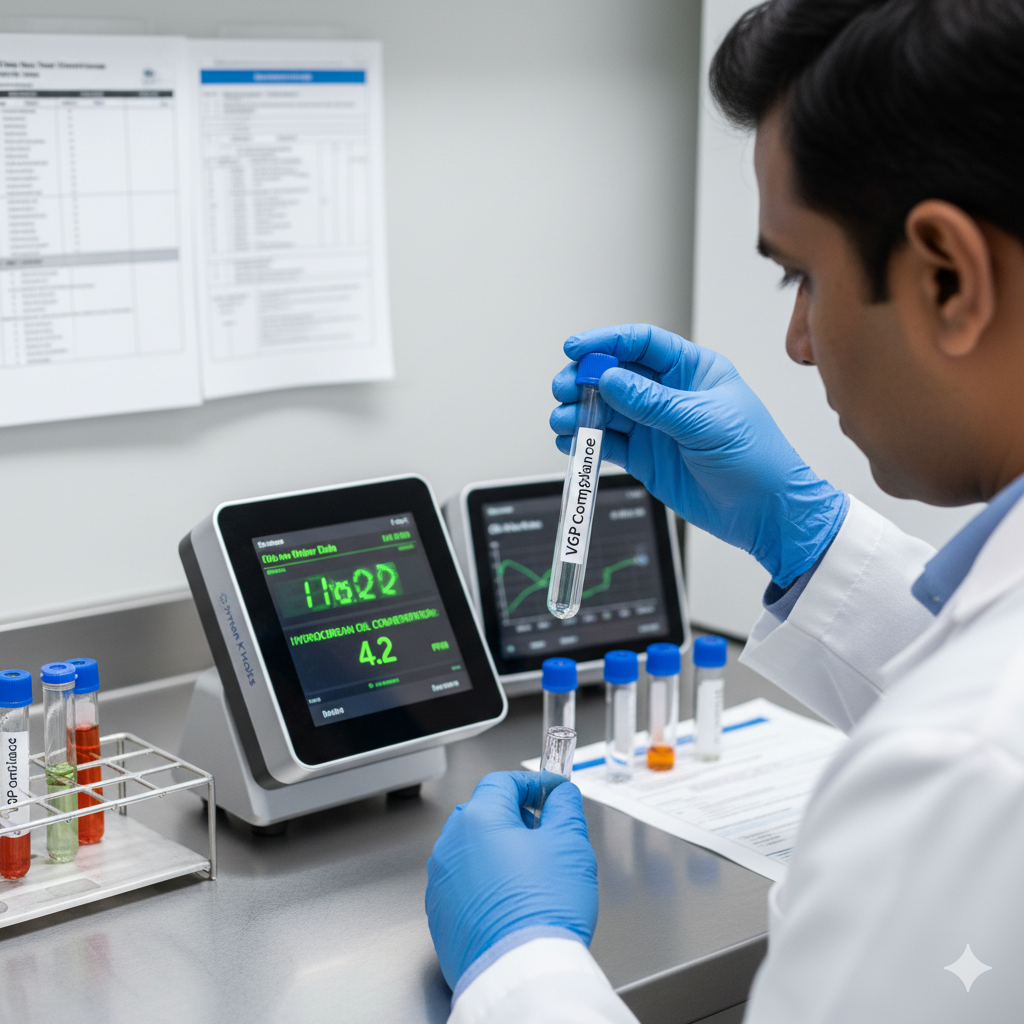
Bilgewater Analytical Method Details
| Analyte | Method | MRL | Unit | Sample Container | Sample Volume | Preservation | Holding Time |
| HEM | EPA-1664A | 5.0 | mg/L | Any color wide-mouth glass bottles | Two 1-liter bottles | Cool to ≤6°C, HCl or H₂SO₄ to pH < 2 | 28 days |
| Hydrocarbon Oil Index | ISO 9377-2:2000 | 0.1 | mg/L | Amber glass bottles with Teflon® lid | Two 1-liter bottles | Cool to ≤6°C | 4 days |
Greywater Monitoring Requirements under the 2013 VGP
The U.S. Environmental Protection Agency (EPA) considers untreated greywater to be similar to domestic sewage, and in some cases, it may contain even higher concentrations of certain pollutants. Because of this, the 2013 Vessel General Permit (VGP) requires monitoring of greywater discharges from certain vessels.
Applicability
Greywater monitoring applies to vessels that discharge into U.S. waters under the VGP and meet either of the following conditions:
- The vessel was constructed on or after December 19, 2013, has a maximum crew capacity of 15 or more, and provides overnight accommodations for crew; or
- The vessel is subject to Part 2.2.15.1 of the 2013 VGP
Owners or operators of vessels that discharge graywater into waters regulated under the Vessel General Permit (VGP) must collect and analyze two samples per year, spaced at least 14 days apart. The results of these samples must be included in the vessel’s Annual Report.
Samples must be analyzed for:
- Biochemical Oxygen Demand (BOD)
- Fecal coliform or E. coli
- Suspended solids
- pH
- Total residual chlorine
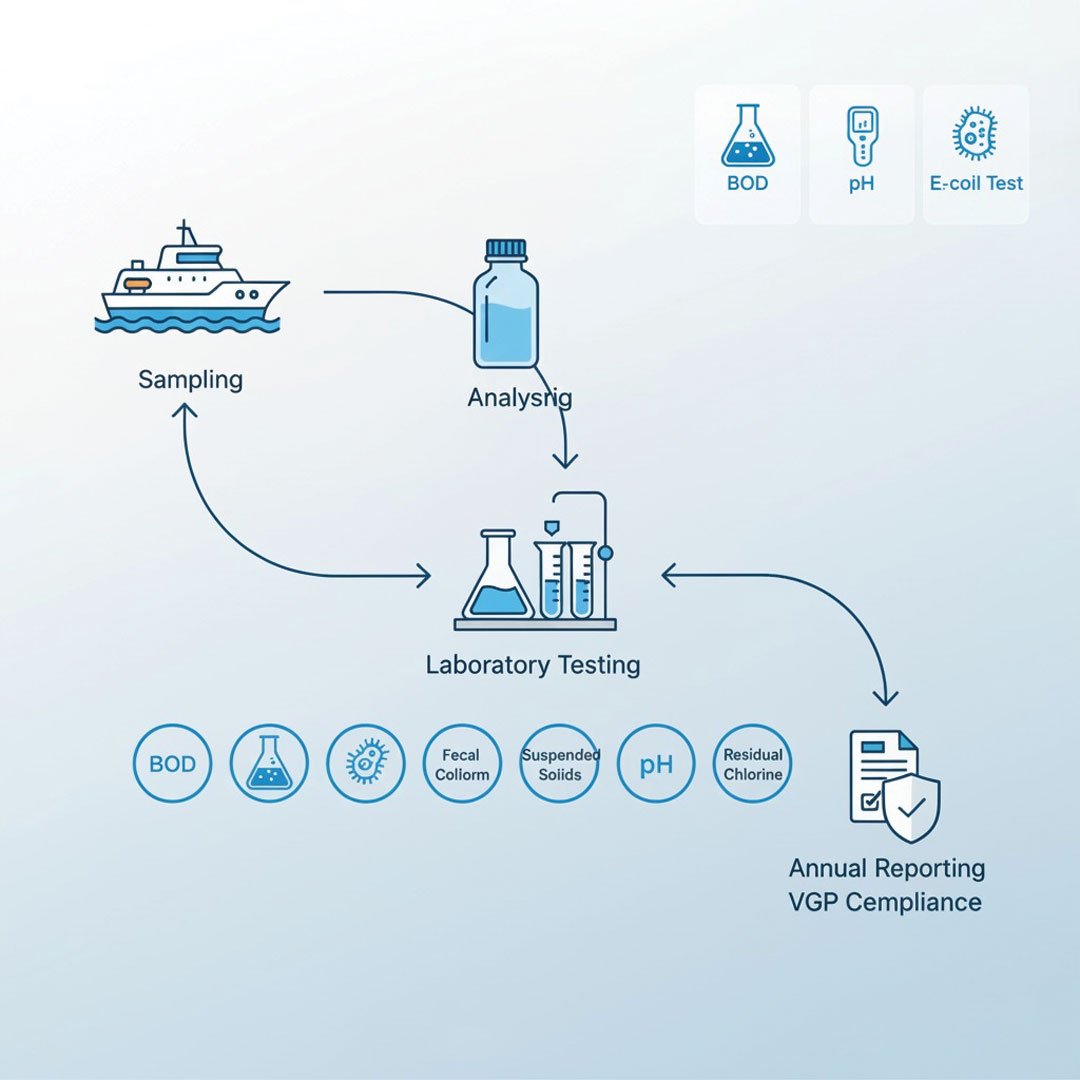
If vessels face difficulty analysing fecal coliform or E. coli within the required holding times, this parameter may be analysed once per year.All sampling and testing must follow the procedures outlined in 40 CFR Part 136. If the vessel is subject to Part 2.2.15.1, the measured samples must comply with the standards specified therein.
Gray water Analytical Method Details
| Analyte | Method* | MRL | Unit | Container | Sample Volume | Preservation | Maximum Holding Time |
| BOD | SM 5210 B | 2 | mg/L | 1 Plastic Bottle | 500-mL | Cool, ≤10°C | 48 hours |
| Fecal Coliform | SM 9222D or 9221E | 1 | CFU or MPN/100 mL | 1 Plastic Bottle | 120-mL | Cool, ≤10°C, Na2S2O3 if Chlorine Present | 8 hours |
| E. coli | EPA 1603 | 1 | CFU or MPN/100 mL | 1 Plastic Bottle | 120-mL | Cool, ≤10°C, Na2S2O3 if Chlorine Present | 8 hours |
| Total Suspended Solids | SM 2540 D | 3 | mg/L | 1 Plastic Bottle | 1-Liter | Cool, ≤6°C | 7 days |
| pH | SM 4500-H B | Field Tests | |||||
| Total Residual Chlorine | SM 4500-Cl G | Field Tests |
Scrubber Wash Water Analysis Services
Exhaust Gas Cleaning Systems (EGCS), or scrubbers, help vessels meet sulphur emissions limits. However, the wash water discharge from these systems must also meet environmental standards.
At Smart Knots, we provide scrubber wash water analysis services fully aligned with the latest guidelines from the International Maritime Organization (IMO) and the U.S. Environmental Protection Agency (EPA). Our services ensure:
- ISO 17025 compliance
- Proper sample handling and holding times
- Complete chain-of-custody documentation
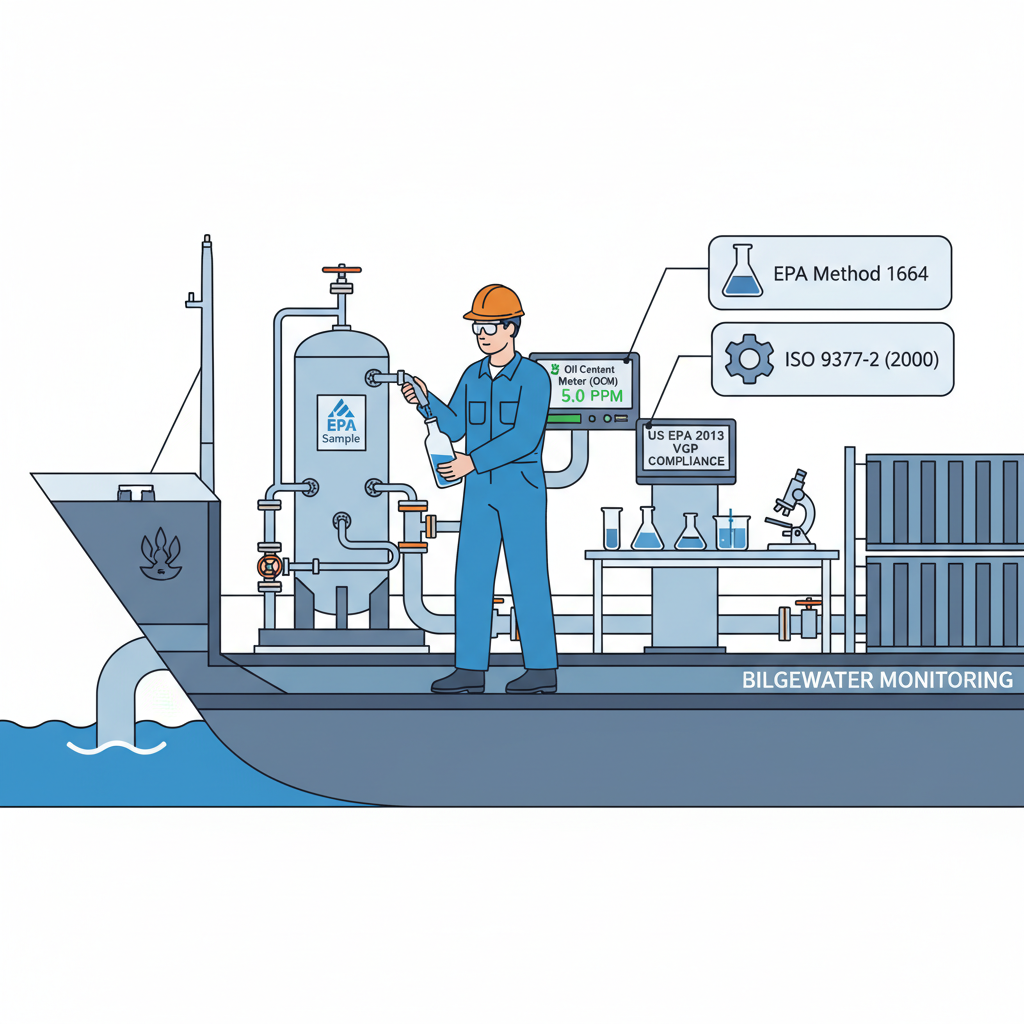
Analytes for Exhaust Gas Scrubber Wash water
| Analytical Group | Specific Compounds |
| Dissolved Metals | Arsenic Cadmium Chromium Copper Lead Nickel Selenium Thallium Vanadium Zinc |
| Total Metals | Arsenic Cadmium Chromium Copper Lead Nickel Selenium Thallium Vanadium Zinc |
| Polycyclic Aromatic Hydrocarbons (PAHs) | Acenaphthylene Acenaphthene Anthracene Benz[a]anthracene Benzo[ghi]perylene Benzo[a]pyrene Benzo[b]fluoranthene Benzo[k]fluoranthene Chrysene Dibenz[a,h]anthracene Fluoranthene Fluorene Indeno[1,2,3-cd]pyrene Naphthalene Phenanthrene Pyrene |
| Nitrite/Nitrate | |
| pH |